Monday, October 12, 2026
Trivia of the Day
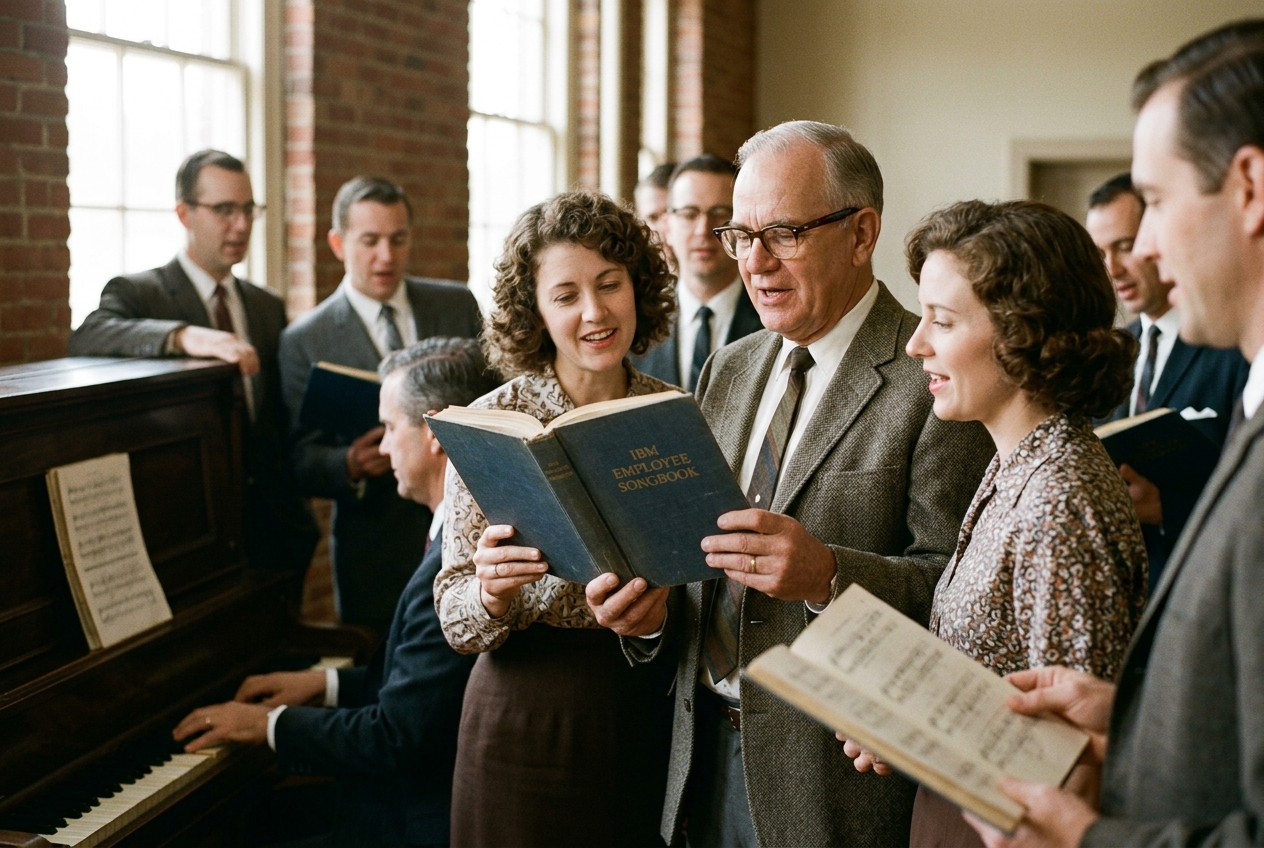
Which Fortune 500 company required new employees to memorize company songs from an official songbook until 1950?
- IBM's employee songbook requirement
- General Electric's company anthem program
- AT&T's corporate choir tradition
- DuPont's workplace morale songs
Answer: IBM's employee songbook requirement — IBM's songbook included over 75 loyalty anthems with titles like "Ever Onward" and "Hail to IBM," sung to melodies borrowed from college fight songs and patriotic marches.
The Singing Salesforce
Thomas J. Watson Sr. introduced IBM's songbook tradition in the 1920s, importing a motivational tactic he had witnessed at National Cash Register under John Patterson. Watson believed group singing built esprit de corps and reinforced company values in an era when IBM was expanding from tabulating machines into a national sales operation. The first official "Songs of the IBM" debuted in 1925 with a dozen tracks, and by 1935 the collection had swelled to over 75 company anthems. New hires received their songbooks during orientation alongside policy manuals, and salesmen were expected to know at least a half-dozen choruses by heart. Regional managers opened Monday meetings with a rousing rendition, and the annual sales conventions in Endicott, New York, featured hours-long sing-alongs that participants described as equal parts pep rally and tent revival. Watson himself often conducted from the stage, leading thousands of dark-suited salesmen through verses praising punch cards and customer service.
The Lyrics Behind the Loyalty
The songbook borrowed liberally from American musical tradition, setting corporate devotion to the tunes of college fight songs, gospel hymns, and patriotic marches. "Ever Onward" adapted the melody of a University of Michigan anthem, while "Hail to IBM" echoed "The Battle Hymn of the Republic." Lyrics extolled product reliability ("We're bound for greater heights, our punch cards lead the way"), praised Watson personally ("T.J. Watson is our inspiration"), and framed sales targets as noble crusades. Some songs addressed specific machines by model number, celebrating the virtues of the Type 405 Alphabetical Accounting Machine in three-part harmony. Employees who composed new entries could submit them for consideration, and Watson himself penned several verses. The tone ranged from martial to maudlin, but the message was uniform: IBM was not merely an employer but a movement, and every salesman was a missionary carrying the gospel of mechanized data processing to businesses still mired in ledger books and filing cabinets.
The Reality Behind the Ritual
While Watson framed the songbook as voluntary morale-building, accounts from former employees reveal a more complicated picture. Salesmen who refused to sing or who fumbled lyrics in front of managers found themselves sidelined for promotions, and regional quotas were sometimes announced mid-chorus to heighten emotional stakes. At the 1939 World's Fair, IBM staged a pavilion where uniformed employees sang hourly performances for fairgoers, blurring the line between corporate culture and public spectacle. Some participants genuinely embraced the tradition, crediting group singing with fostering camaraderie during the Depression-era grind of door-to-door sales. Others privately resented the pressure, describing the practice as performative tribalism that reduced professional relationships to a loyalty test. Watson doubled down during World War II, adding patriotic verses that conflated IBM's punch cards with the Allied war effort, but by 1945 younger employees began quietly pushing back, viewing the songbook as an embarrassing relic of a paternalistic era increasingly out of step with postwar corporate norms.
The Quiet Fadeout
Watson Sr. officially retired the mandatory songbook in 1950, citing changing workforce expectations and the company's evolution into a global technology firm. His son, Thomas Watson Jr., who took over in 1952, actively discouraged the practice, later writing in his memoirs that the sing-alongs had "outlived their usefulness" and risked making IBM look cultish to potential recruits. The last official printing of "Songs of the IBM" occurred in 1949, though regional managers reportedly kept the tradition alive in pockets through the mid-1950s. Today the songbook is a curiosity, studied by business historians as an artifact of midcentury corporate paternalism and by skeptics as a cautionary tale about the fine line between company culture and coercion. IBM's transformation into a computing giant was built on the sales force Watson trained, but the employees who powered that growth remember less the melodies than the quotas, less the harmony than the hustle it was meant to amplify.
What most people get wrong
Many assume IBM's songbook was a quirky one-off invented by eccentrics, but it was actually modeled on National Cash Register's employee choir program and reflected a widespread 1920s belief that group singing improved factory and office productivity—dozens of firms published similar songbooks.
Sources & further reading
Word of the Day
paean noun · PEE-uhn
a song of praise or triumph, often exaggerated or fervent
“The consultant's quarterly deck read less like analysis and more like a paean to synergy, complete with fourteen slides on corporate values.”
Joke of the Day
Why did the IBM salesman refuse to audition for the church choir after 1950?
He'd already hit his lifetime quota of mandatory group singing.
This Day in History
1492 — Christopher Columbus made landfall in the Bahamas, mistaking it for the East Indies and launching a transatlantic exploration race funded by venture capital of the era—Spanish crown investment seeking new trade routes and gold reserves that would reshape global commerce for centuries.
Enjoyed this issue?
Get the next one free, every morning.
More from Get Rich Slower