Sunday, October 18, 2026
Trivia of the Day
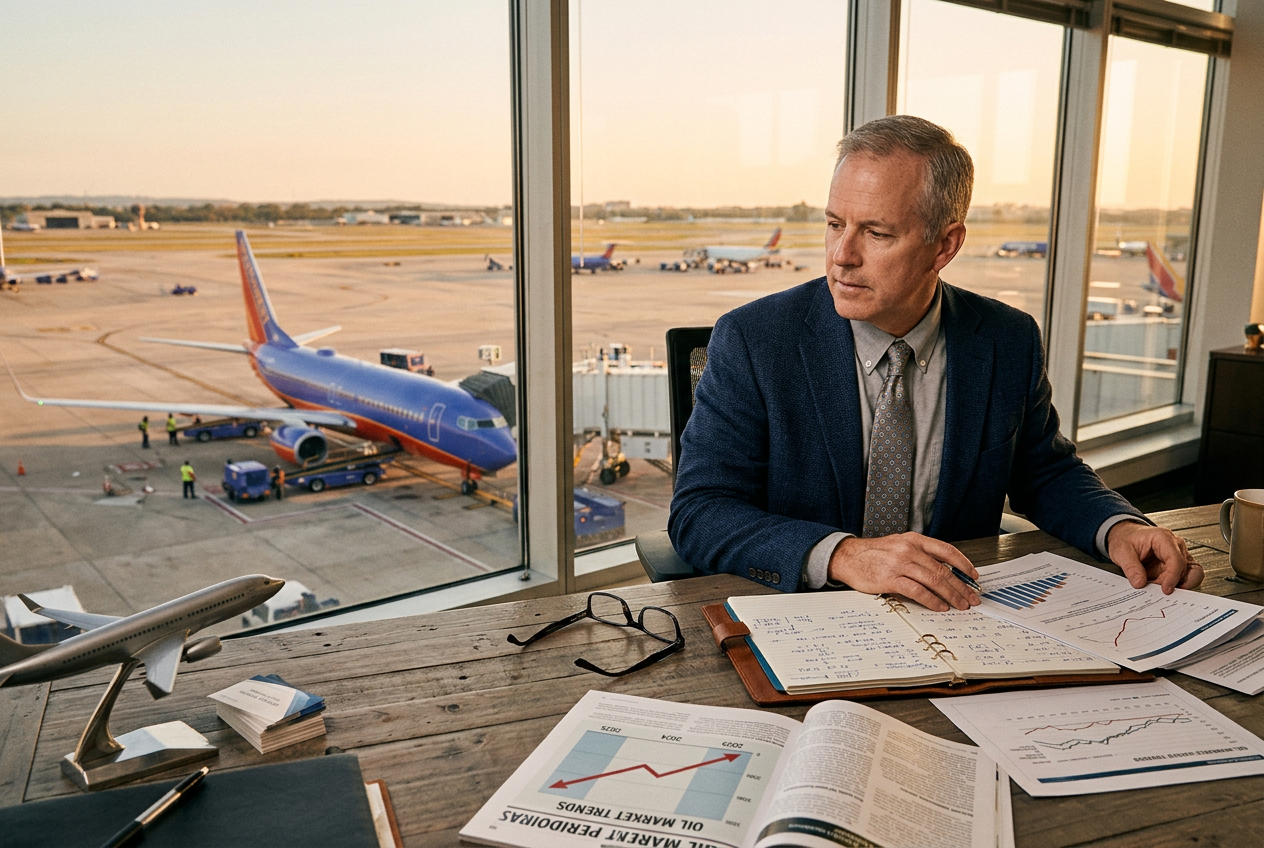
Which airline turned a routine financial hedging practice into a billion-dollar profit center that competitors couldn't replicate?
- Southwest Airlines hedging strategy
- Delta's fuel refinery acquisition
- JetBlue's futures trading desk
- United's commodity speculation unit
Answer: Southwest Airlines hedging strategy — Southwest's fuel hedging profits between 2005 and 2008 exceeded the combined net income of American, United, and Delta during the same period.
The Boring Bet That Became a Goldmine
In 1999, Southwest Airlines did something every airline does: it hedged fuel costs. The idea is simple insurance—lock in a price today so a spike tomorrow doesn't ground your fleet. But Southwest's risk team, led by a former trader who understood oil markets better than most energy companies, saw something competitors missed. Oil was cheap, volatility was low, and long-dated contracts were practically free. So they didn't hedge six months out like everyone else. They locked in prices as far as a decade ahead, betting billions that oil wouldn't stay at $20 a barrel forever. By 2008, Southwest had hedged roughly 70 percent of its fuel at an effective price below $50 per barrel while competitors were paying $140. The difference wasn't just savings—it was a profit center that dwarfed the razor-thin margins of actually flying passengers.
Most airlines hedge maybe 30 percent of fuel for the next quarter, treat it like an accounting footnote, and call it a day. Southwest built a derivatives book so large it required SEC disclosure and a dedicated trading desk in Dallas. Between 1999 and 2008, the airline reported over $3.5 billion in fuel hedging gains—more than many legacy carriers earned from operations in the same decade. In 2007 alone, Southwest's hedging profits hit $727 million, which represented roughly 40 percent of its net income that year. The strategy wasn't speculation; it was long-term contracting married to a balance sheet strong enough to post collateral when oil dipped and margins turned against them temporarily. While American and United bled cash as oil climbed past $100, Southwest reported 64 consecutive profitable quarters, a streak no competitor came close to matching during the 2000s.
Why Rivals Couldn't Copy the Playbook
Every airline knew what Southwest was doing—the hedges were public, the gains were in every earnings call, and analysts wrote case studies. So why didn't Delta or United just do the same thing? First, balance sheets. Hedging long-dated oil contracts requires posting collateral, and when oil moves against you even temporarily, the margin calls can run into hundreds of millions. Southwest entered the 2000s debt-free with billions in cash; legacy carriers were leveraged, hemorrhaging money on pensions, and couldn't afford to tie up capital in derivatives that might not pay off for years. Second, timing. By the time competitors tried to ramp up hedging programs in 2004 and 2005, oil had already doubled and the cheap contracts were gone. United locked in fuel at $60 in 2006 and thought it was clever—then oil hit $147 in 2008 and Southwest's decades-old hedges were still paying off at $30.
There's also a cultural difference that doesn't show up in quarterly reports. Southwest's finance team had the authority and the trust to make long-term bets that wouldn't pay off for years, even if they looked expensive in the short term. Legacy carriers, beholden to quarterly earnings pressure and activist investors, couldn't stomach the optics of spending billions on hedges that might lose money in year one. In 2005, Gary Kelly, Southwest's CEO, told analysts the airline would keep hedging aggressively even if oil prices fell—a statement that would've gotten him fired at most other carriers. The strategy worked until it didn't: by 2009, oil crashed to $40, Southwest's hedges were suddenly underwater, and the profit center that had minted billions became a $400 million loss. The airline quietly scaled back, closed the trading desk, and went back to conservative hedging. The window had closed, and no one in the industry ever rebuilt that kind of edge again.
The Legacy Nobody Talks About
Southwest's hedging windfall is the kind of thing business schools love and CFOs pretend never happened. It's awkward to admit that an airline made more money from oil contracts than from selling tickets, or that a decade of competitive advantage came from a bet most competitors were too broke or too cautious to make. But the strategy reshaped the industry in ways that outlasted the profits. It proved that airlines could use financial engineering to survive oil shocks that would've bankrupted them a decade earlier, and it forced every carrier to build hedging desks that, while smaller, became standard operating procedure. Southwest's hedging gains subsidized the low fares that put pressure on competitors, accelerated consolidation as weaker carriers couldn't keep up, and changed how Wall Street values airline stocks—fuel hedging disclosure is now a key metric in every earnings report.
Today, no airline hedges the way Southwest did in the 2000s. Regulations tightened after the financial crisis, long-dated oil contracts are more expensive, and balance sheets are too thin to support the kind of speculative positions Southwest ran. But the lesson stuck: financial tools matter as much as operational efficiency, and sometimes the biggest competitive edge isn't a better product—it's a better bet. Southwest still hedges fuel, but modestly, in line with peers, and the glory days of turning the finance department into a profit center are long gone. The hedging strategy didn't just make billions—it bought a decade of dominance that competitors spent the next 20 years trying to recover from.
What most people get wrong
Most people assume Southwest's hedging success was just lucky timing—buying cheap and selling high. In reality, it required a decade-long commitment, billions in capital reserves to withstand margin calls, and a corporate culture willing to stomach short-term losses for long-term protection. Competitors knew the strategy but couldn't afford to execute it.
Sources & further reading
Word of the Day
contretemps noun · KON-truh-tahn
An unexpected mishap or hitch; an awkward clash or dispute, often arising from bad timing.
“When oil crashed in 2009 and Southwest's hedges turned into a $400 million loss, the CFO called it 'a minor contretemps'—analysts called it the end of an era.”
Joke of the Day
Why did the Southwest fuel trader refuse to play blackjack after 2008?
He'd already doubled down on oil for a decade—and the house finally won.
This Day in History
1969 — On October 18, 1969, the FTC ordered Campbell Soup to stop placing marbles in the bottom of soup bowls during photography shoots to make vegetables appear more plentiful in ads—one of the first rulings that advertising must depict products as they actually are, not as staging tricks make them seem.
Enjoyed this issue?
Get the next one free, every morning.
More from Get Rich Slower