Wednesday, October 21, 2026
Trivia of the Day
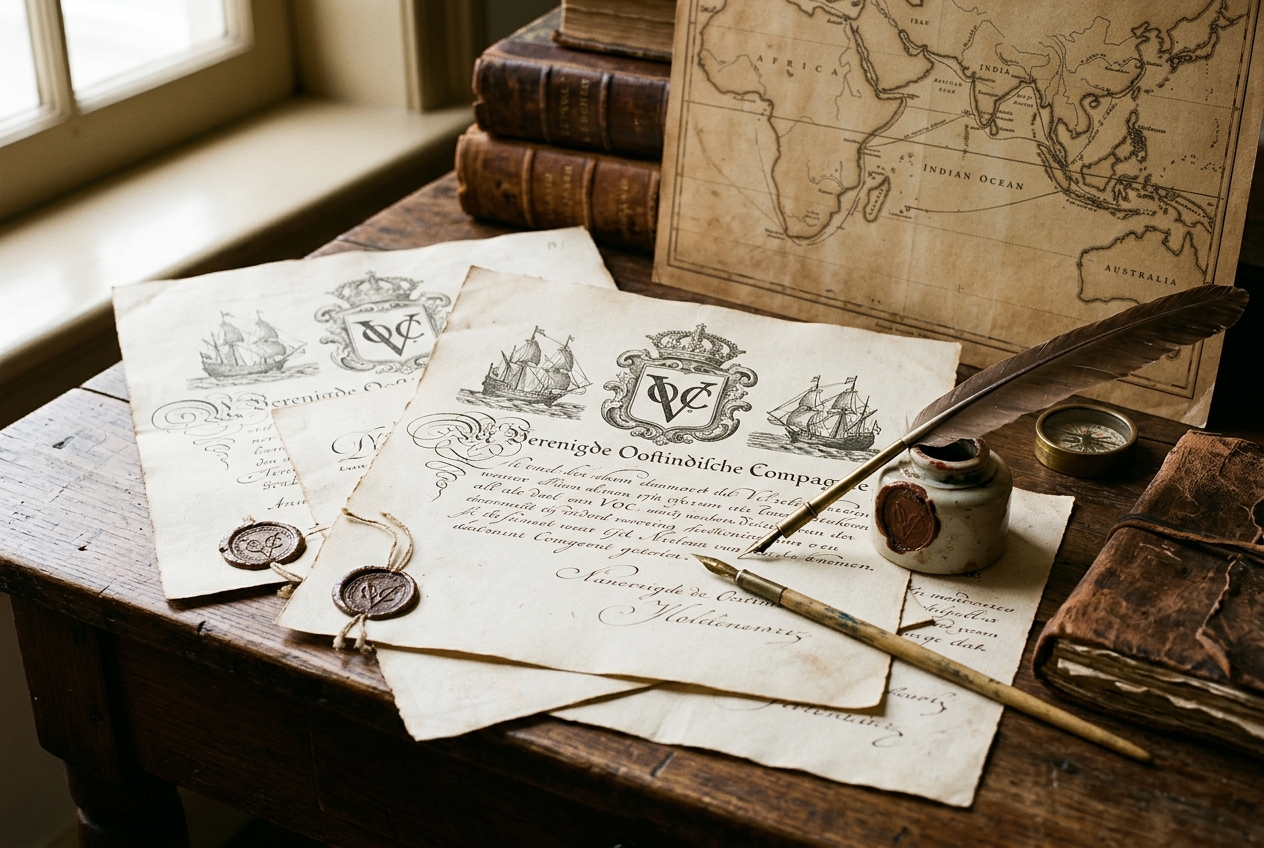
Which company issued the first publicly traded shares on a stock exchange, creating the template for modern corporations?
- the British East India Company's royal charter
- the Dutch East India Company's stock structure
- the Bank of England's subscription model
- the Mississippi Company's share system
Answer: the Dutch East India Company's stock structure — The Dutch East India Company remained the world's most valuable corporation for nearly 200 years, worth roughly $7.9 trillion in today's dollars at its 1637 peak.
The Liquidity Gambit
Before 1602, raising capital meant finding partners who committed until the venture dissolved—every voyage, every cargo run triggered a full accounting and payout. The Verenigde Oostindische Compagnie changed that on March 20, 1602, when its charter created a permanent joint-stock structure with shares tradeable among investors without company consent. Within months, the Amsterdam Stock Exchange opened to handle the secondary market, and by 1607 over a thousand shareholders held VOC paper, from Amsterdam merchants to Middelburg widows. The innovation wasn't incorporation itself—guilds and chartered monopolies existed—but separating ownership from operation and making that ownership transferable. A shareholder could cash out by selling to another investor rather than forcing liquidation, which meant the company's capital stayed locked in ships, forts, and spice warehouses while its ownership changed hands daily.
The Actual Mechanism
The VOC's charter divided capital into shares of roughly 3,000 guilders each, issued across six regional chambers—Amsterdam held the largest stake at 3.67 million guilders of the initial 6.45 million capitalization. Shareholders received a participation certificate, or actie, marking their stake, and the company promised dividends from Asian trade profits but set no end date for operations. The charter granted a 21-year monopoly on Dutch trade east of the Cape of Good Hope and west of the Strait of Magellan, backed by the States General, which meant the VOC could wage war, sign treaties, and coin money in Asia. Trading began informally at the Oude Brug, then moved to the newly built exchange building on Rokin by 1611, where twice-daily sessions let investors buy and sell VOC shares alongside commodities. By 1650, the Amsterdam exchange handled options, futures, and margin trading on VOC paper—financial instruments that wouldn't appear in London for another generation.
The Unintended Consequence
Permanent capital created permanent grievance. Shareholders quickly realized they had no mechanism to force management accountability between the rare general meetings, which the six-chamber structure made nearly impossible to coordinate. In 1609, Isaac Le Maire—an original subscriber who'd sold his shares and now held a short position—published the first investor activism pamphlet, accusing the VOC directors of self-dealing and demanding regular audits. The company ignored him, and the States General backed management, establishing a pattern that lasted decades. The VOC paid dividends erratically—sometimes in cash, often in spices that shareholders had to sell themselves—and published almost no financial information until the 1620s. By 1622, the original charter's expiration approached, and shareholders organized to demand liquidation and a full accounting; the directors instead lobbied for charter renewal, which they received, along with another 21 years of operational secrecy. The permanent corporation had arrived, and so had the permanent tension between shareholders and management.
Why It Still Shapes Markets
Every modern stock exchange descends from the Amsterdam model—shares representing permanent equity, traded among investors, priced by supply and demand rather than company diktat. The VOC's structure solved the capital problem that limited earlier ventures: English trading expeditions still liquidated after each voyage into the 1650s, returning capital and profit before the next subscription. Continuous operation let the VOC build infrastructure across Asia—forts at Batavia, warehouses in Nagasaki, administrative offices in dozens of ports—that no per-voyage partnership could afford. The British East India Company adopted a similar permanent structure only in 1657, and the London Stock Exchange formalized trading decades after Amsterdam. The separation of ownership and control, the liquid secondary market, the tension between shareholders and directors—all emerged in those first decades of VOC trading. Even the financial engineering: Isaac Le Maire's 1609 short position makes him arguably the first recorded short seller, and the tulip mania speculation of the 1630s played out in the same coffeehouses where traders swapped VOC shares.
What most people get wrong
Most people assume the British East India Company came first or that stock markets began in London; in fact, the Dutch VOC predated its British counterpart's permanent structure by 55 years, and Amsterdam's exchange opened before London formalized equity trading.
Sources & further reading
Word of the Day
disquisition noun · dis-kwih-ZIH-shun
a long or elaborate essay or discussion on a particular subject
“The activist investor's 47-page disquisition on corporate governance reforms landed on every board member's desk with a thud.”
Joke of the Day
Why did the VOC shareholder refuse to check his portfolio in 1799?
Because after 197 years of dodgy dividends and zero transparency, watching the final liquidation would've been too on-brand.
This Day in History
1978 — On October 21, 1978, Frederick W. Smith testified before Congress that Federal Express was weeks from collapse without regulatory relief—the Civil Aeronautics Board's flight restrictions had forced FedEx to use small jets on each route, making overnight delivery unprofitable. Deregulation passed five days later; FedEx turned its first profit within a year.
Enjoyed this issue?
Get the next one free, every morning.
More from Get Rich Slower