Thursday, October 22, 2026
Trivia of the Day
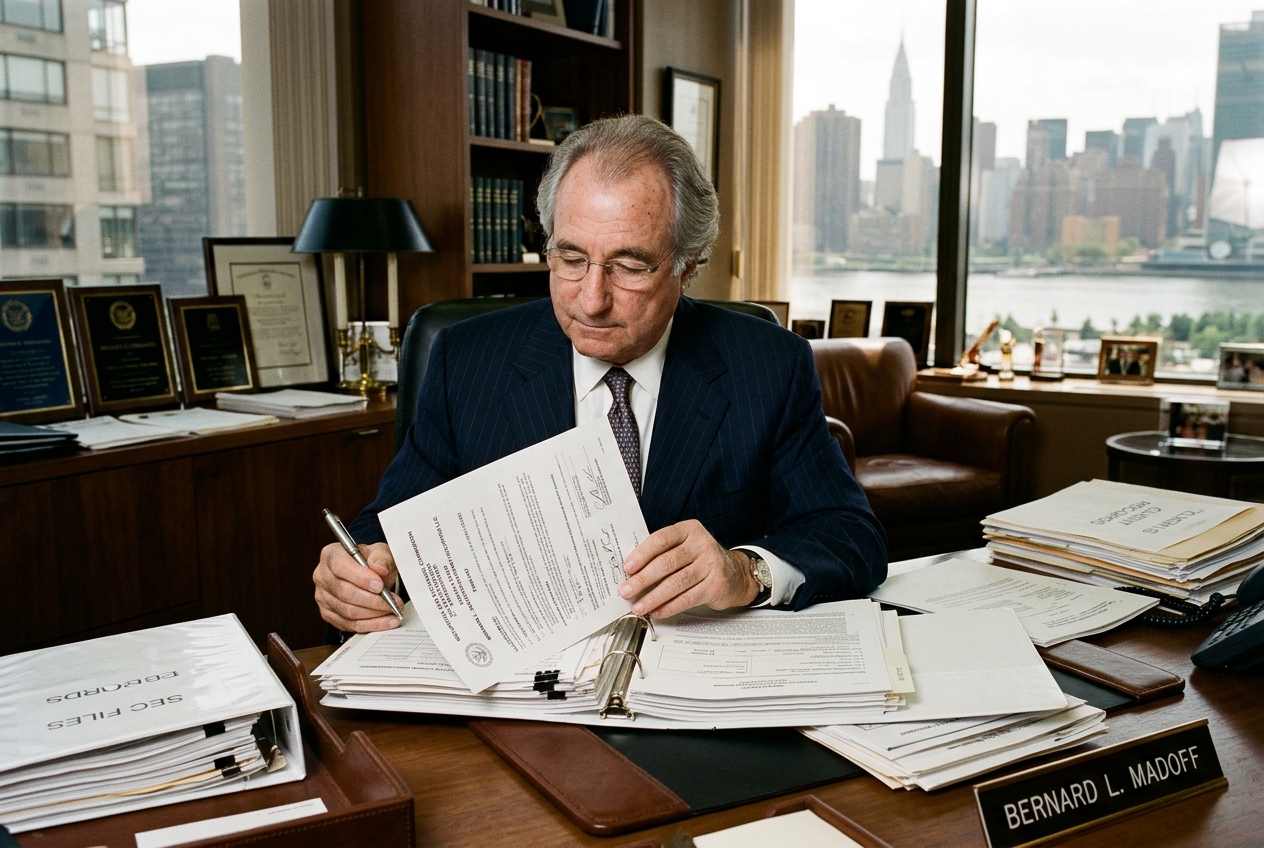
What regulatory status did Bernie Madoff voluntarily apply for in 2006, three years before his arrest?
- A federal bank charter
- Bernie Madoff's SEC registration
- FINRA arbitration panel membership
- NYSE specialist designation
Answer: Bernie Madoff's SEC registration — Madoff's voluntary SEC registration in 2006 meant he could now be inspected—yet the SEC never conducted a single examination of his advisory business before his 2008 collapse.
The Foxes Apply for Henhouse Duty
In 2006, Bernard L. Madoff Investment Securities LLC filed paperwork with the Securities and Exchange Commission to register as an investment advisor. The move was voluntary. For decades, Madoff had operated his advisory business—the one running the largest Ponzi scheme in history—without SEC registration, exempt under a rule for advisors with fewer than fifteen clients. By registering, he subjected himself to examinations he had previously avoided. The decision puzzled some observers at the time, since registration meant opening the books. But Madoff had survived multiple SEC inquiries already, and may have calculated that the legitimacy stamp outweighed the risk. His firm managed money for feeder funds and high-net-worth individuals, and the SEC badge offered reassurance to skeptics who occasionally surfaced.
The 2006 registration came after Congress passed a law requiring more investment advisors to register. Madoff's firm had grown beyond the small-advisor exemption, and he could have restructured to remain unregistered. Instead, he filed Form ADV in September 2006, listing his advisory business and disclosing that he managed billions. The form went live on the SEC's public database, and Madoff's name appeared alongside thousands of other registered advisors. He paid the registration fee, agreed to the rulebook, and promised to keep records available for inspection. For clients and feeder funds, the registration was a green flag. For Madoff, it was another layer of camouflage—regulatory status as protective coloring.
The Inspections That Never Happened
Despite the new registration, the SEC never examined Madoff's investment advisory business between 2006 and his December 2008 arrest. The agency had investigated him multiple times before—1992, 1999, 2004, 2006—but those inquiries focused on his broker-dealer operation or on specific complaints, not the advisory business itself. After the 2006 registration, Madoff's name entered the SEC's exam queue, but no inspector ever showed up. The agency later admitted it had no record of scheduling or conducting an examination. Meanwhile, Madoff's firm continued to fabricate trade confirmations, invent account statements, and shuffle money from new investors to pay redemptions. His advisory business had zero actual securities positions and no real trading activity, yet the SEC's oversight apparatus never detected it.
The registration created a paper trail and a compliance obligation. Madoff filed annual updates to Form ADV, reporting his assets under management and describing his investment strategy as split-strike conversion using blue-chip equities and options. The filings were public, searchable, and detailed. They also claimed he had custody of client assets, a red flag that should have triggered heightened scrutiny. But the SEC's examination program was backlogged, understaffed, and focused on higher-risk targets. Madoff's firm had a long operating history, a clean regulatory record, and a chairman who had served on NASDAQ's board. The combination made him look low-risk. In reality, the lack of an exam gave Madoff three more years to operate unchecked, allowing the fraud to grow from an estimated eighteen billion in client funds in 2006 to sixty-five billion in claimed account balances by 2008.
The Human Cost of a Bureaucratic Gap
When Madoff's scheme collapsed in December 2008, thousands of investors discovered their account statements were fiction. Retirees lost life savings, charities shuttered, and feeder funds vaporized. Among the victims were Holocaust survivor Elie Wiesel's foundation, which lost fifteen million dollars, and the family foundation of Madoff's own sister. Many investors had believed their money was safe precisely because Madoff was a registered investment advisor, a status that implied SEC oversight. The 2006 registration had served as a credibility marker, a signal that regulators had vetted and approved him. In reality, no vetting had occurred. The SEC's failure to examine Madoff after his registration became a central fact in post-collapse investigations and lawsuits.
The Irving Picard, the court-appointed trustee liquidating Madoff's firm, later recovered billions through clawback lawsuits against investors who had withdrawn more than they deposited. But many victims received only partial reimbursement, and some received nothing. The emotional toll was severe—some investors reported clinical depression, and at least two suicides were linked to Madoff losses. One victim, Thierry de la Villehuchet, a French aristocrat who had invested his family's money with Madoff, was found dead in his Manhattan office a week after the scheme unraveled. He had lost everything. The gap between the regulatory promise implied by Madoff's 2006 registration and the reality of zero oversight created a credibility wound the SEC spent years trying to repair.
Why Registration Without Examination Still Matters
The Madoff case forced a reckoning with how financial regulation actually works. Registration does not equal supervision, and a government database entry does not mean an agency has checked the books. In 2009, the SEC's inspector general issued a scathing report detailing the agency's repeated failures to catch Madoff despite multiple investigations and the 2006 registration. The report found that examiners had failed to verify Madoff's claims, accepted implausible explanations, and never asked his purported custodian bank whether any securities existed. Congress responded by increasing the SEC's examination staff and budget, and by tightening rules around custody and surprise audits. The reforms aimed to close the gap between registration as a formality and registration as a meaningful checkpoint.
Today, investment advisors are examined more frequently, and the SEC uses data analytics to flag suspicious patterns like impossibly consistent returns or custodian mismatches. But the fundamental lesson remains uncomfortable: regulatory status is a starting point, not a safety net. Madoff's 2006 decision to register was strategic, not altruistic, and it worked. He gained credibility, faced no new scrutiny, and operated for three more years. The collapse eventually came not from an SEC exam but from a liquidity crisis—clients demanded seven billion in redemptions Madoff could not meet, and he confessed to his sons on December 10, 2008. The voluntary registration that should have been a red flag became instead a false assurance, a reminder that trust in institutions requires institutions to actually do the work.
What most people get wrong
Many assume Madoff's 2006 SEC registration triggered closer scrutiny or that the agency inspected him after he registered. In fact, the SEC never conducted a single examination of his advisory business following the registration, and the status functioned mainly as a credibility signal to investors.
Word of the Day
recourse noun · REE-korss
A source of help or a legal right to demand payment or compensation, especially when a deal goes sideways and someone needs to recover losses.
“The feeder fund had zero recourse against Madoff's firm once the Ponzi scheme collapsed, since every contract clause favored the fraudster.”
Joke of the Day
Why did the Ponzi operator volunteer for an IRS audit?
He figured if he could fool the SEC six times, the tax guys would be a breeze.
This Day in History
2002 — The New York Stock Exchange announced it would shift from fractional pricing (eighths and sixteenths of a dollar) to full decimal pricing, completing a transition that started in 2000. The move closed a centuries-old tradition and eliminated a built-in advantage for market makers who profited from wide spreads.
Enjoyed this issue?
Get the next one free, every morning.
More from Get Rich Slower